Reviewer handbook > Reviewing instructions
=========> For easier navigation in the Handbook, please use the “Browse” and not the “Main Menu” in the left menu.
Thank you very much for reviewing for Interspeech 2026!
Your reviews are due on the 10th of April 2026!
The Technical Program Committee relies on your expertise to help decide which submissions will be accepted and which will be rejected. As the common proverb says, “with great power comes great responsibility” - as a reviewer, you have certain guidelines to keep in mind. Please read all of the following important information before starting your reviews.
We all are different - as individuals, researchers and as reviewers. As a reviewer, you should nonetheless attempt to push your “personal likes” aside and provide balanced and fair reviews. Your feedback comments will be forwarded to the authors, and they will also help Interspeech 2026 to decide the outcome of the paper, and justify the decision for the authors. If the paper is accepted, the comments should guide the authors to improve the presentation of their final manuscript.
This Reviewer Handbook gives you guidelines on what to pay attention to when writing your reviews for Interspeech 2026. If you have questions that this handbook does not answer, please contact your meta-reviewer as a primary contact for clarifications. We are starting a new initiative to offer optional Area-specific Reviewer Guidelines. Currently, this page only contains guidelines for Area 7 relating to speech synthesis evaluation, but we hope other areas will also contribute helpful guidelines in the future. The Technical Program Committee Chairs of Interspeech also warmly welcome your feedback and suggestions for improving this handbook: <TPC-chairs@interspeech2026.org>
¶ Use of Generative AI to produce a review
Interspeech follows the ISCA Code of Conduct for Reviewers and Meta-Reviewers. It states in particular for Generative AI:
Manuscripts or parts of the manuscripts under review must never be uploaded to public or commercial GenAI platforms that transmit data externally, retain inputs for training, or lack confidentiality agreements. Their use is permitted only on firewall-protected or institutionally approved systems that guarantee confidentiality.
When GenAI is used, it should be under the following restrictions:
- GenAI cannot be used to assess the originality, novelty, or correctness of the manuscript.
- GenAI outputs cannot be used as authoritative scientific evidence.
- Peer reviewers should verify that GenAI outputs do not introduce or reinforce bias against methodological approaches, demographic groups, or research paradigms used in the manuscript.
- Any use of GenAI must be acknowledged in the review with a sentence summarizing how it was used.
- Peer reviewers will remain fully responsible for the accuracy, fairness, and professionalism of the review, regardless of GenAI assistance.
¶ Author checklists (for your reference)
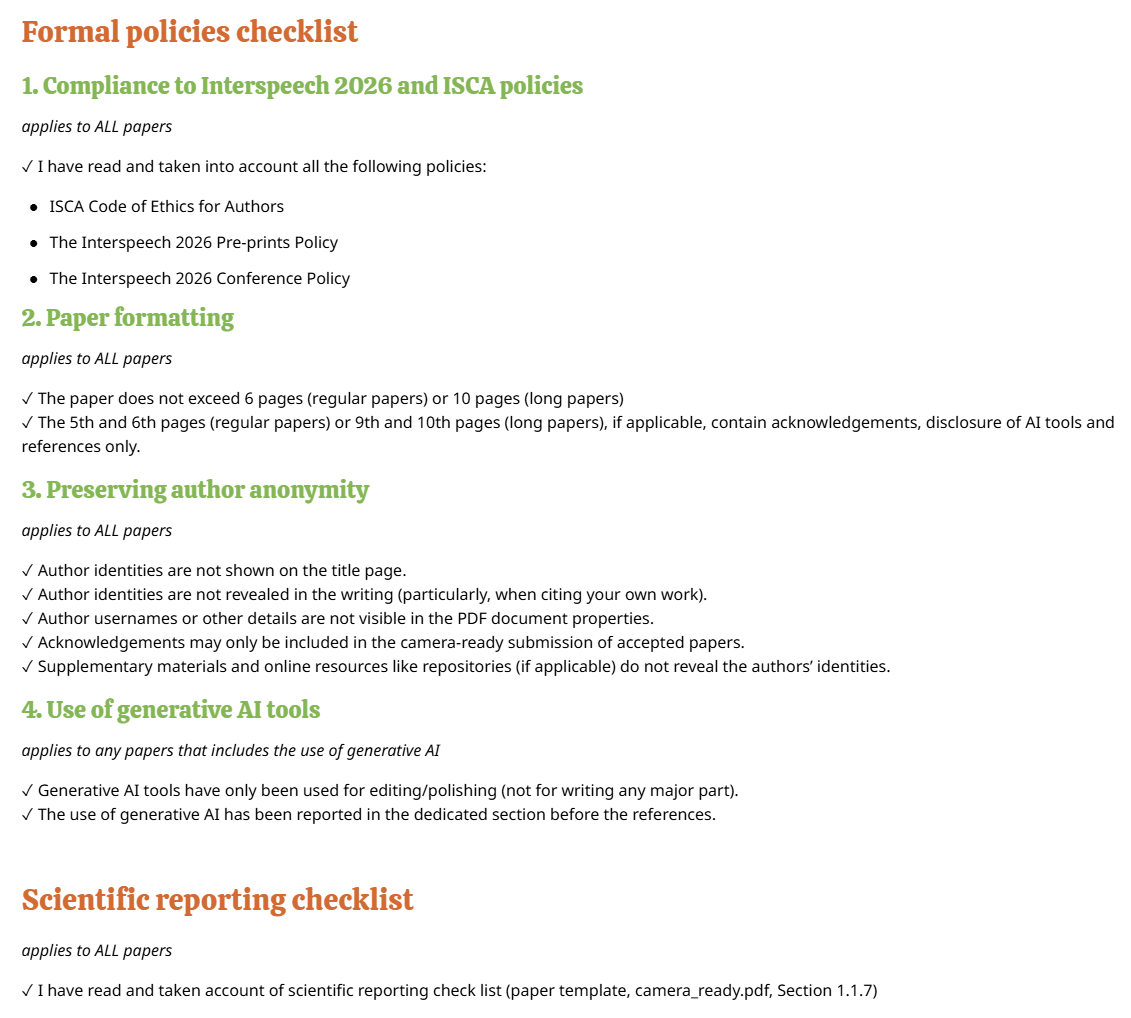
The Interspeech 2026 submission instructions included a “quick author checklist” to help authors pay attention to the important aspects (see further details under author resources and paper submission in the website). Some checks relate to conference and ISCA policies, others to best practices in scientific reporting. The scientific reporting checklist can be located in the paper kit (camera_ready.pdf, Section 1.1.7).
While we hope that these checklists may help you to pay attention to certain aspects, every paper is different. There is no such thing as “the one and only correct way” for writing a scientific paper. Please review the papers as you would usually do. The checklist here is provided for your reference only, as a (partial) reminder on what to pay attention to.
¶ Anonymity and confidentiality
The review process is double-blind.
- Paper contents must remain confidential, during and after review.
- Do not make any attempt to discover author identity or affiliation.
- It may be difficult for papers about data sets, toolkits, or entries to challenges, to completely hide author affiliation. Do not penalize such papers.
- Please be particularly careful when opening supplementary material or visiting links entered in the paper as they may reveal authors' identity.
If, for any reason, you come to suspect or know the identity or affiliation of the authors, please let the meta-reviewer know as soon as possible so that they can attempt to assign a different reviewer. You may be asked to still do the review if it is not possible to find a replacement. In that case, please indicate in the confidential comments of the review form that you know or suspect the authors' identities or affiliations and explain how this might have affected your review (those responses will not be seen by the authors).
“DON'T”s:
- do NOT share printed versions (or show the paper from screen) with anyone.
- do NOT leave print-outs anywhere where they could be discovered by your colleagues.
- do NOT talk about ideas, methods or experiments presented in the paper with anyone.
- do NOT do web search on title, abstract (or any other elements) to find out who the authors or their institutes are.
“DO”s:
- do inform your meta-reviewer if you discover the identities of the authors or their institutes.
¶ As a reviewer, what should I pay attention to?
Your main task is to assess the merits of the paper along three distinct dimensions:
- Originality (Novelty) - What is new (and is it new enough)?
- Technical or methodological correctness - Is the presented research sound?
- Clarity - Have the authors articulated their research clearly enough (to be understood by other researchers)?
We provide further details in the following three sections.
¶ 1. Originality
Whereas all scientific research builds upon earlier work (that's why we include bibliography sections to our papers), your task is to assess the extent to which the paper adds to the existing body of knowledge - and whether that is substantial enough. “Has not been done before” is not always sufficient; it can be easy to suggest ideas, tasks, models, datasets, analyses that have not been done before - but much harder to put forward ones that address a meaningful knowledge gap in the field of research.
Some of the following guiding questions might be helpful in your assessment of originality:
- Are the tasks or methods new?
- Are previously-known techniques combined in novel ways?
- Is the work a description of a new publicly released dataset?
- Is related work adequately cited and the new contributions explained?
Sometimes it is obvious what the novelties are, some other times this could be subtle - for instance:
- A study that uses an otherwise established/known approach could be novel if the approach is adopted or used in ways that have not been reported in prior studies.
- An approach claimed to be novel could have already been re-circulated dozens of times in the literature, or be a trivial modification of an existing one.
- A simple method can be novel, and a complex method may lack novelty. Do not use simplicity (or complexity) of the method as a proxy for originality.
- Good performance or a large model (e.g. top-performing model on a task, database or a benchmark) does not automatically mean that the model or idea is new. Performance does not automatically imply that the paper must be “automatically accepted”. Whereas performance is an important for certain studies, it should not be taken as the only criterion when you assess originality.
Please keep in mind that there are many different kinds of novelties (in tasks, methods, datasets, research protocols, theoretical developments, etc.), depending on the study and research approach taken. One study may also have multiple novelties. It is important that you are aware of the type of contribution, since different kinds of studies require slightly different originality assessments. As a new feature to Interspeech 2026, we ask your help to classify the type of the scientific or technological contribution presented:
| TYPE OF CONTRIBUTION | POSSIBLE QUESTIONS TO KEEP IN MIND WHEN YOU ASSESS ORIGINALITY (intended as an example, NOT as an exhaustive list) |
| Original theoretical or conceptual contribution | Is the theory or concept new and well-motivated? Are the connections, differences similarities to earlier similar theories or concepts clearly explained? |
| New model, algorithm, architecture, or recipe | Is the model or algorithm new (and justified for the tasks being addressed) - or a trivial/obvious modification of an existing one? If the components or algorithms are already known, is their combination novel, or are there some novel aspects in the empirical validation? |
| New corpus, software toolkit, or experimental protocol | Is the need for a new corpus, software or protocol justified and clearly explained? Is the composition of the dataset, its recording / collection or design principle novel? Does the software toolkit provide functionalities not already available in similar existing ones? |
| New application | Does the paper present a new application not known by the community? Does it adapt an existing approach to a novel domain? If it presents an implementation important for practitioners / industry, is it different from the existing solutions? |
| Case study to address a phenomenon in speech science | Is the phenomenon being addressed new? If an ‘old’ one, are there novelties in the collection of data, selected user populations, research methodologies? Does the study advance understanding / provide previously less known insights to the phenomenon under investigation? |
| Replication study (validates or challenges previous knowledge) | Is the need and motivation for the replication study (e.g. unresolved question or question without community consensus) justified and explained? Do the findings support (or conflict) earlier research or claims in ways that leads to improved understanding? |
| A review article or critical literature survey | Is the scope of the review or survey justified? Does it collect ‘dispersed’ literature into a useful summary? Does the paper give a new perspective that has not been addressed in similar recent surveys/reviews? |
| Other OR unable to determine | (Use ONLY if the contribution does not clearly fall under any of the above categories OR if you are unable to determine the type of the study) |
Pay attention whether you are reviewing a regular, long or special session paper. Interspeech 2026 has regular, long and special session papers. Please be mindful of this distinction as (again) the novelty assessment required could be different. IF you are assigned to review special session or challenge papers (Area 14), please familiarize yourself with the “special” characteristics from the conference website for challenges or special sessions. A special session paper may address topics that are “rare” to a speech conference. Do not penalize authors for possible deviations from the mainstream or popular themes.
Finally, do not confuse ‘originality’ for ‘relevance’. Your task is NOT to judge whether or not the paper addresses an “interesting”, “relevant”, or “hot” topic ! Focus on whether the research presents an advancement to the field (fills a knowledge gap of need), regardless of what your personal preferences on “interesting” kind of study might be. You are not the judge for deciding how relevant or interesting another member in the community will find a paper. We all have our personal likes and preferences. Although you may find a paper of limited interest, it may still have technical merit, and could be interesting to others.

¶ 2. Technical or methodological correctness
Please evaluate the scientific and/or technical correctness of the work. If experiments are presented please consider if enough details are provided on the datasets, baseline and experimental design to allow the experiments to be reproduced or equivalent experiments run. Are measures of statistical significance presented? Are the author's responses to the checklist satisfactory?
A potential caveat relating to available compute / dataset access / participant recruitment: Please keep in mind that not everyone has access to the same facilities, e.g., computational power, databases, or large pools of participants. Judge a paper on its own, given the facilities available to the authors. Please try to keep an open mind.
¶ 3. Clarity
Besides being novel and methodologically correct, the scientific results are always communicated to other researchers. Please evaluate the clarity of the presentation of the work. Take into account the writing, organization, and quality of figures, tables etc. The English does not need to be flawless, but the text should be understandable.
¶ What kind of comments should I write - any advice for structuring my review?
As an author, what kind of feedback YOU would like to receive about your own study?
Most likely you will answer professional, constructive, detailed, and to-the-point. That is the kind of feedback that helps you to improve your research, writing, know about possible methodological shortcomings - and perhaps even get ideas for future research. In contrast, with all the likelihood the kind of feedback that you do NOT like to receive are hostile, unjustified or arbitrary comments that make you feel that the reviewer has not even read your paper (or seem to have used not more than 10 seconds to read it) - or is attacking you or your research personally. Reviewing is a ‘peer-to-peer’ activity. It might be helpful if you think your role more as “the critical, but friendly fellow scientist”, as opposed to “a police”. This does NOT mean that you should remain positive if the study clearly lacks novelty, is methodologically flawed, or written unclearly. As a reviewer, it is your task to spot such issues. Regardless of your view on the paper, you should be respectful to the authors when writing your feedback.
Pay special attention to the following:
- Be detailed (as detailed as your time allows) and constructive. One-liners like “it's a nice paper” or “the performance isn't good enough" are useless to both the authors and the Interspeech organizers. They do not help either to know what is missing, wrong, or requires improvements. Especially when you disagree with the authors, you need to provide substantiated arguments to explain your evaluation. Please provide the necessary explanations, justifications and details for all of the important arguments. For instance, if the authors have missed an important reference (no one is expected to know every possible paper), give the bibliographic details. If the paper lack specific experimental comparisons (no one is expected to know about every possible dataset or method), mention which dataset, method or protocols they should include (and why so). If there is an obvious methodological flaw (there are a good number of junior scientists submitting to Interspeech) - be sure to provide details about what the authors have misunderstood and how the authors should address the task in future.
- Be respectful and avoid offensive language in your feedback. No matter how “upset” you might be about a particular paper (that happens to everyone who reviews enough papers), avoid offensive language by all possible means. Keep in mind that you do not know the authors or their background. No one writes bad papers on purpose to annoy you. Regardless of what is your view (as a domain expert) is, remain respectful. Let the authors know the shortcomings in a professional tone.
- Avoid statements that suggest “conditional” acceptance. Interspeech does not implement a “major revision" phase. The submitted papers are expected to be in their (almost) final versions, with only minor changes allowed to the camera-ready version. Since you will not be given a chance to review a revised manuscript, please make up your mind whether your final recommendation leans towards acceptance or rejection. Avoid conditional (if-then) statements such as "If the authors conduct the following additional experiments, the paper can be accepted". If the paper clearly lacks an important experiment, method, dataset, omits prior research (etc) that could compromise methodological or technical correctness, your recommendation must be ‘Reject’ or ‘Weak Reject’.
- Use the confidential comments box (when you must). While Interspeech 2026 encourages for full transparency in the communication between reviewers and authors, there are situations when you may wish to withhold some comments from the authors, and include them solely for the committee's internal use. Typical examples include (but are not limited to):
- when you may want to express a very strong (negative) opinion on the paper, which might offend the authors in some way;
- when you wish to write something which would expose your identity to the authors;
- when you wish to let the Interspeech organizers know that you are less confident in your review;
- when you observe signs of plagiarism, or use of AI tools in writing the paper (or similar complex ethical questions);
- when you suspect you know the authors or their institutes, and you believe this might bias (positively or negatively) your evaluation of the paper.
How do I structure my feedback?
While you may have your personal preference how to structure your comments, in CMT we provide the following recommended template. CMT does not allow this template to be pre-filled in the feedback box, so please copy & paste it.
-------------------------------------------------------
Summary of the paper:
Major strengths or weaknesses (taking into account originality, technical correctness, clarity):
Minor issues:
Justification for the overall recommendation:
-------------------------------------------------------------------
The last point, justification for the overall recommendation is very important. Both the authors and the Interspeech organizers should understand clearly your reasoning for the final numerical rating, especially if your view leans towards the lower scores (Reject or Weak Reject).
¶ Reasons for NOT rejecting paper (not an exhaustive list)
- You would have preferred a different research question.
- The work is done in a language or speech type you do not know/like/prefer.
- You do not have access to the task/challenge/data.
- You vaguely recall seeing something similar (but cannot point a reference)
¶ Should I try to target a certain percentage of papers to be accepted or rejected?
No. Don't worry about recommending too many papers to be accepted (or too many to be rejected) - focus on originality, correctness and clarity based on the papers. Each paper has three assigned reviewers, and the technical program committee will take all their feedbacks into account. When filling in your numerical ratings, avoid being indecisive (i.e., by scoring most papers in the middle of the numerical range). Please take a stand - either you like a paper or you don't.
¶ Other miscellaneous practical matters
¶ Offline review
If you prefer working offline, you can also download the template, update it offline and upload the review later in CMT.
In CMT, with your reviewer role, go to Actions > Import reviews and you can download there the template that you can modify and upload later on. It is in XML format.
Further details from the dedicated CMT help page.
¶ Papers removed from assignment list
For various reasons (author withdrawal, ethical issues, better paper-reviewer match, etc.) papers can be removed from your assignment list. No automatic email is however sent by CMT in that case.
Be sure to check regularly your assignments to avoid proceeding with a review that is no longer needed.
¶ Author rebuttal
A rebuttal to reviewer comments will be offered to the authors.
The rebuttal will not be sent back to the reviewer but will help the meta-reviewer to write the meta-review and the committee to decide the acceptance/rejection of the paper.
¶ Reviewer form
This form has to be filled when entering your review in CMT. For the first time this year, Interspeech 2026 has reduced the number of text boxes where you can fill in your review to one single box (under question 9). This is why it is so important to copy & paste the template into the text box to address all the important aspects of the review.
| Question | Possible answers | |
|---|---|---|
| 1. ISCA Code of Conduct agreement* | I certify that this review complies with the ISCA Code of Conduct for Reviewers and Meta-Reviewers (https://isca-speech.org/https/www.isca-speech.org/Code-of-Conduct-for-Reviewers-and-Meta-Reviewers). | (Click) |
| 2. Use of Generative AI agreement* | Manuscripts or parts of the manuscripts under review must never be uploaded to public or commercial GenAI platforms that transmit data externally, retain inputs for training, or lack confidentiality agreements. Their use is permitted only on firewall-protected or institutionally approved systems that guarantee confidentiality. When GenAI is used, it should be under the following restrictions: - GenAI cannot be used to assess the originality, novelty, or correctness of the manuscript. - GenAI outputs cannot be used as authoritative scientific evidence. - Peer reviewers should verify that GenAI outputs do not introduce or reinforce bias against methodological approaches, demographic groups, or research paradigms used in the manuscript. - Any use of GenAI must be acknowledged in the review with a sentence summarizing how it was used. - Peer reviewers will remain fully responsible for the accuracy, fairness, and professionalism of the review, regardless of GenAI assistance. |
(Click) |
| 3. Introduction and agreement to ethical guidelines* |
As a reviewer, your task is to assess (1) originality, (2) technical correctness, and (3) clarity. Please supply your detailed comments to back up your numerical score in each of these three dimensions. For more details, please refer to the Reviewer Handbook: https://wiki-is.isca-speech.org/en/Technical-Programme/Reviewer-handbook/Home Your comments will be forwarded to the authors. They will also help Interspeech 2026 to decide the outcome of the paper, and justify the decision for the authors. If the paper is accepted, the comments should guide the authors to improve the presentation of their final manuscript. Interspeech 2026 is committed to fairness and confidentiality throughout the peer-review process. Please carefully review (and agree to) the following ethical guidelines: 1. You are responsible for your review - do not outsource your review to anyone else. Keep the contents confidential. (visible to authors during feedback, visible to authors after notification, visible to meta-reviewers, visible to senior meta-reviewers) |
(Click) |
| 4. Confidential comments |
Use this field for any comments you wish to withhold from the authors, such as suspected plagiarism or unethical use of AI tools. If you suspect that you know who the authors are, mention it here. If you want to express a very strong (negative) opinion on the paper, which might offend the authors, write it here. (visible to meta-reviewers, visible to senior meta-reviewers) |
Free text (8000 char.) |
| 5. Reviewer confidence* |
By selecting a value, you confirm that you are competent to evaluate this paper. If you have doubts about your ability to assess it, do not complete this form but instead use "Contact Meta-Reviewer" (visible to authors during feedback, visible to authors after notification, visible to meta-reviewers, visible to senior meta-reviewers) |
1: Sufficiently Confident 2: Confident 3. Very Confident |
| 6. Type of scientific or technological contribution* |
Please assess the type of contribution. Tick all applicable options. If the type of contribution is not listed, or if you are unable to determine it, please select the last option (only). (visible to authors during feedback, visible to authors after notification, visible to meta-reviewers, visible to senior meta-reviewers) |
- Original theoretical or conceptual contribution - New model, algorithm, architecture, or recipe - New corpus, software toolkit, or experimental protocol - New application - Case study to address a phenomenon in speech science - Replication study (validates or challenges previous knowledge) - A review article or critical literature survey - Other OR unable to determine (please write in comments) |
| 7. Originality (novelty) score* | (visible to authors during feedback, visible to authors after notification, visible to meta-reviewers, visible to senior meta-reviewers) | 1: Not novel 2: Minor novelty 3: Sufficiently novel 4: Very novel |
| 8. Technical or methodological correctness score* | (visible to authors during feedback, visible to authors after notification, visible to meta-reviewers, visible to senior meta-reviewers) | 1: Severely flawed 2: Significant flaws that may call results into question 3: Minor issues but credible results 4: Technically solid |
| 9. Clarity of presentation score* | (visible to authors during feedback, visible to authors after notification, visible to meta-reviewers, visible to senior meta-reviewers) | 1. Difficult to follow 2. Difficult to read, requires major revision 3. Clear enough, could benefit from some revision 4. Very well written |
| 10. Overall recommendation* | (visible to authors during feedback, visible to authors after notification, visible to meta-reviewers, visible to senior meta-reviewers) | 1: Reject: I think this paper should be rejected 2: Weak Reject: I am leaning to reject this paper 3: Weak Accept: I am leaning to accept this paper 4: Accept: I think this paper should be accepted |
| 11. Feedback and justification of your numerical scores* |
Please provide your comments to the authors here, including justification for your numerical scores. We recommend you to use the following template (copy & paste it to the text field). (visible to authors during feedback, visible to authors after notification, visible to meta-reviewers, visible to senior meta-reviewers) |
Free text |
| 12. Nominate for Best Student Paper Award* |
(Answer this question by assuming the first author is a student. The Chairs will filter out non-student papers after review.) Please provide arguments in favour of the award in the next question. Your answer will not be visible to authors. (visible to meta-reviewers, visible to senior meta-reviewers) |
- Yes - No |
| 13. Explanation for nomination for Best Student Paper Award | (visible to meta-reviewers, visible to senior meta-reviewers) | Free text (2000 char.) |